

What is a Sauna Master?
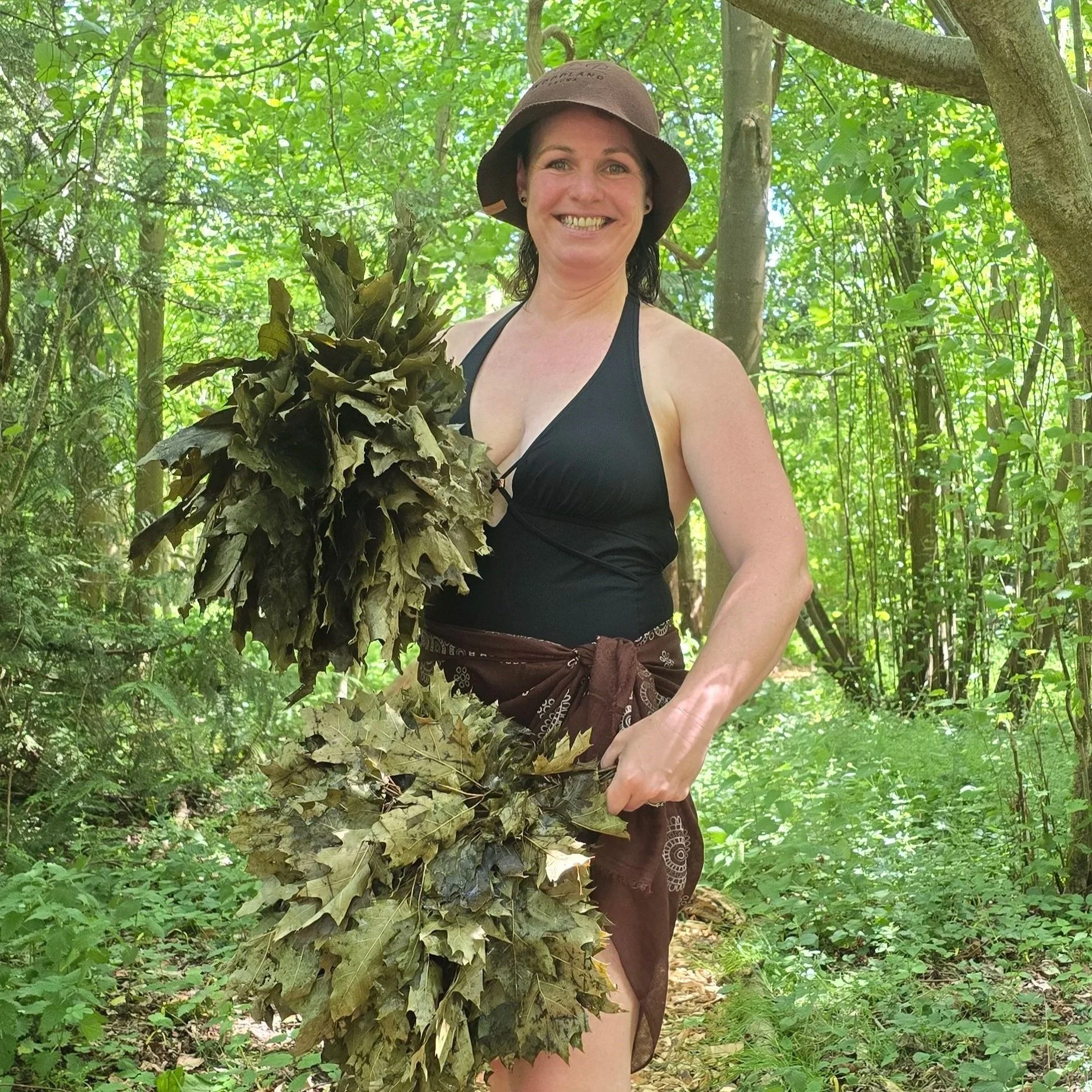
Sauna Master Chantelle with her Oak Whisks
If you've spent any time in UK wellness circles recently, you'll have noticed something shifting. Saunas are no longer tucked away in the corners of leisure centres or reserved for luxury spa days. They're appearing on beaches, in forests, at festivals, beside rivers and lidos. Community saunas are opening across the country. People are talking about heat, cold, breath, and ritual in ways that feel genuinely new and genuinely old at the same time. We are, many are saying, in the middle of a sauna renaissance.
And with that growth comes a term you might be starting to hear more often: sauna master.
It's a title that can sound a little mysterious, even a little serious, if you haven't encountered it before. So what does it actually mean? What does a sauna master do? And why did I become one?
My Journey Here
My connection to heat and cold goes back further than any formal training. Growing up with a wonderfully multicultural circle of family friends, I found sauna culture a normal part of life in many of the homes we visited. Family holidays sometimes took us to remote villages, mountain rivers, and the kind of cold that arrives as adventure rather than conscious intention. I didn't think of any of it as wellness back then, it was just invigorating fun.
In adulthood, that relationship deepened gradually. Years of cold water immersion, guided breathwork, and training in mindfulness and meditation began to shape something, a growing understanding of what it means to truly connect with the body and work with it rather than against it. Each practice felt like a piece of something larger.
Then, in April 2025, I trained with Dr. Susanna Soeberg in the Thermalist Method, a specific, evidence-based approach to using cold, heat, and breath together as tools for health and wellbeing. It gave me the scientific grounding to understand why these practices work, not just that they do.
But science only tells part of the story. This year, in May, I went deeper into the history, culture, and ceremony of the sauna. The ritual. The human side of it. And what I found moved me in ways I hadn't expected, and I am still sitting with it.
It feels, honestly, like the pieces have been assembling themselves for years. Like this was always where the path was leading. What I've learned so far, and it's very much still in motion, has already begun to shape not just the sauna experiences I want to create, but the way I think about everything I offer. It all feels very aligned.
So, What Is a Sauna Master?
A sauna master is someone trained in the art of guiding a sauna experience. But that single sentence doesn't really do it justice.
This isn't a role about turning up the heat and ladling water on stones. A sauna master shapes the entire arc of a session, the temperature, the humidity, the rhythm, the scent, the silence, the sound. They read the energy of the room and respond to the people in front of them. They hold space. They create conditions for something deeper than relaxation to occur.
Think of it less like a fitness instructor and more like a ceremonial guide, someone who understands both the physiology of heat and the profound human need for stillness, connection, and ritual.
A World of Different Flavours
Step into a Finnish sauna and you'll find something built on simplicity, silence, and reverence. There, the löyly, the steam that rises when water meets hot stones, isn't just a way of managing heat. It's considered, by many, to be the spirit of the sauna itself. It’s life force. The word löyly shares roots with the Finnish word for soul, and old folklore speaks of a löylynhenki, a spirit who lives within the steam. Even today, in the quietest Finnish saunas, you'll find people who treat that rising steam less like a sensation and more like a presence in the room.
Travel to Germany, though, and the energy shifts entirely. Aufguss is theatrical, ceremonial, and highly skilled, a sauna master performing elaborate towel-swinging routines to send heat and steam rippling through the room, layering scent, music, and sometimes narration into something closer to performance art. Or step into a Russian banya, where the venik, bundles of birch, oak, or other plants, becomes both tool and medicine, used to work the body, awaken circulation, and release the properties held in the leaves.
And here in Britain, something new is taking shape, still young, still finding its voice, drawing from all of these lineages while writing its own. We are weaving in breathwork, cold water immersion, sound, story, and nature-based ceremony, and the result is a living, evolving practice rather than a fixed tradition.
What I've come to understand, training in this world, is that no two sauna masters are quite the same. Mastery isn't a single fixed skill; it's shaped by lineage, by training pathway, and just as much by the personality and passions of the person holding the space. Some lean theatrical. Some lean clinical and precise. For me, it's the natural, authentic connection of nature and body, in all its forms, that resonates most deeply.
What Drew Me
Of all these flavours, the path that called to me most deeply was the one most aligned with my values, a natural, authentic approach that places nature, and the connection between nature and body at its very heart.
There is something profound about using the sauna as a space to reconnect with ourselves in the most innate way possible. A reminder that we are human and animal, that beneath the busyness and the noise, we are physical beings with an extraordinary capacity to heal, to feel, and to be present. The sauna, at its best, strips that back. It becomes a place of genuine transformation, mentally, physically, and for our overall well-being, inviting us to face our truest selves, in the stillness and in the heat.
What drew me here was also the sense of community it creates. Not just connection to nature, but connection to the people around you, those who share the heat, the silence, the steam. There is something quietly powerful about that.
My training in this approach, with Jesse Inferno of The Sauna Corner, deepened that conviction. It's a path I'm still walking, one I expect to keep learning on, evolving and transforming, for myself as much as for those I invite into the sauna with me.
The Tools of the Practice
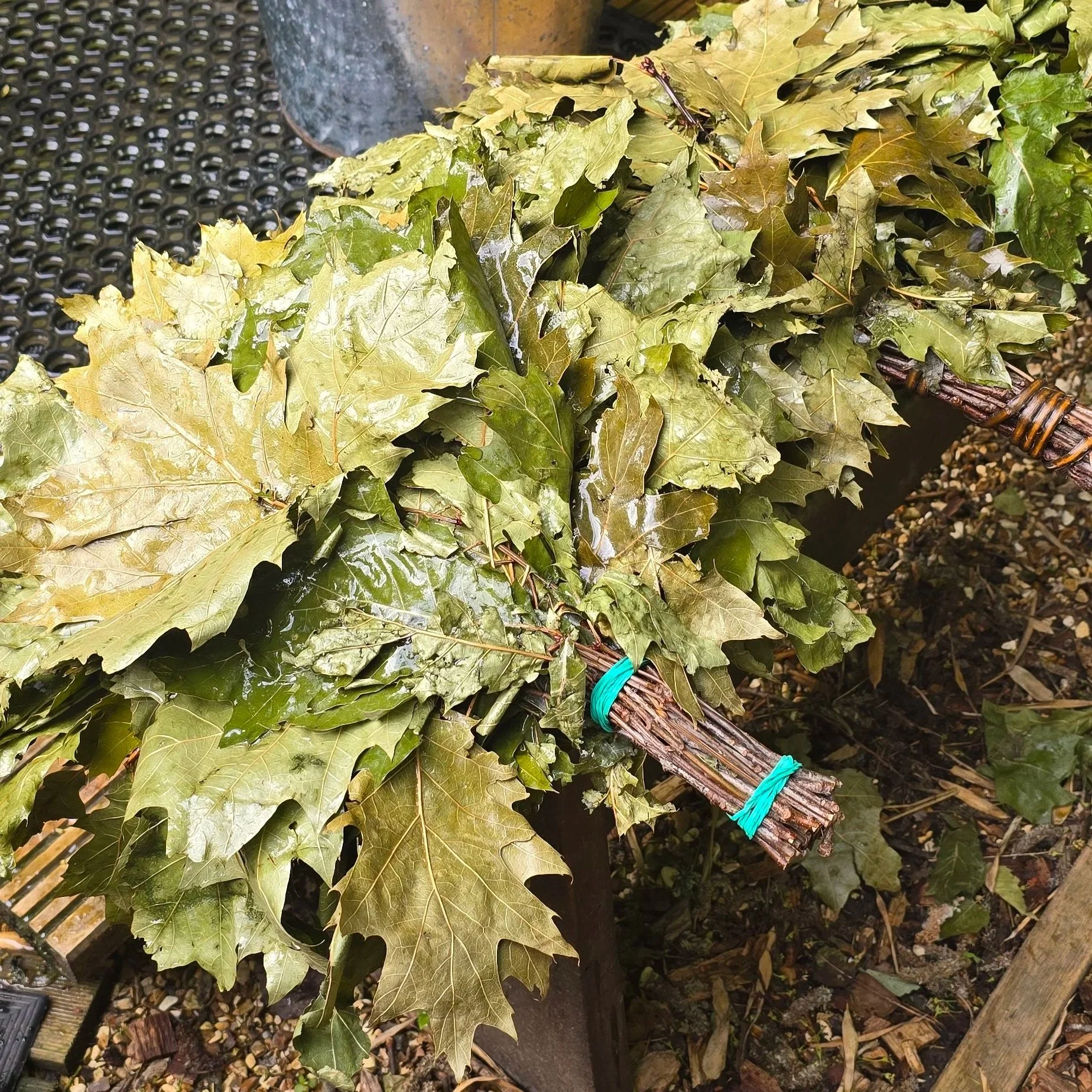
Central to this natural approach are the tools themselves, and they are beautiful in their simplicity.
Whisks have been used in sauna traditions for thousands of years and learning to use them properly is both a study in plant medicine and a deeply meditative practice in its own right. Birch is the most traditional choice: its leaves are known for their anti-inflammatory, cleansing, and skin-softening properties, and its scent is fresh, light, and quietly uplifting. Oak brings something altogether earthier; its leaves are firmer, its properties more firming and grounding, its energy steady and strong. Both have been used for centuries, not just as tools, but as medicine.
But the whisk does far more than most people realise. It is the primary tool for moving the löyly, directing heat and steam around the sauna, bringing warmth to where it's needed, lifting it toward the ceiling or drawing it down around the body. In skilled hands, it becomes a multi-sensory instrument: the gentle swoosh of movement through the air creates sound; the aromatic oils released from the leaves carry scent; and when used in gentle, rhythmic strokes across the skin, it brings warmth, stimulates circulation, and grounds the bather deeply in their body. Heat, sound, scent, and touch, all from a bundle of leaves.
It's worth saying that not every sauna master works with whisks. In the Aufguss tradition, for example, towels and fans are the tools of choice for moving heat and steam through the room. The pathway you train in shapes the tools you reach for. Mine draws from natural materials, whisks, plants, and infusions, and that choice is intentional. It's part of a broader philosophy: that the simplest, most natural tools, used with knowledge and care, are often the most powerful.
Herbal infusions are prepared by steeping or soaking bunches of plants so that their oils and essence infuse the water. When that water is ladled onto the hot stones, the sauna fills with something that feels less like a treatment and more like stepping into an ancient woodland. Eucalyptus that opens the breath. Pine that grounds and steadies. Mint that awakens and clears.
But the natural palette doesn't stop there. A wisp of smoke can carry a session somewhere primal and ancient. Salt, scattered, scented, or used in a scrub, draws on the cleansing, mineral-rich qualities the body has always craved. Sound, whether a single instrument, a voice, or simply the crackle of stones, becomes its own kind of medicine. Even taste can play its part, something sweet, a piece of fruit perhaps, arriving at just the right moment, like a small gift from nature exactly when the body needs it most.
The beauty is always in simplicity. Fire. Water. Plants. Presence. Nothing more is needed, and yet, somehow, it engages every sense we have.
The Sauna as a Portal
One idea from my training has stayed with me more than any other: the sauna as a portal of transformation. Having lived it, immersed in heat, ritual, and genuine human connection, I now understand exactly what that means.
The sauna asks something of us the moment we step inside. It asks us to strip back what doesn't matter. To set down the roles we play, the masks we wear, the constant low hum of doing and performing and managing. In the heat, in the stillness, in the intensity of a peak round, there is nowhere to hide, and that, surprisingly, is where the freedom is.
At the heart of it is the idea of authentic being, showing up without performance, without pretence, without the armour we carry into almost every room we enter. When we do, something opens. The heart. The body. A deeper, quieter part of ourselves that rarely gets space in everyday life. The sauna becomes a place for healing, for recovery, for genuine connection, with the people around you, and with yourself on a level that can be difficult to reach any other way.
What many people discover, sometimes to their own surprise, is the power and love that lives within them when they finally slow down enough to feel it. The sauna doesn't give you anything new. It simply creates the conditions for you to remember what was always there.
During my training, something in me softened that I hadn't realised was tight. I felt held. I felt safe. I felt, perhaps for the first time in a long time, completely and quietly myself, and yet also more alive, more present in my body than I had felt in a long time. It was both a coming home and a waking up.
That is what I want to offer others. Not a treatment. Not a performance. A genuine invitation to arrive, in the heat, in the moment, and in yourself.
What a Sauna Ritual With Me Looks Like
A guided sauna session is always a journey. My sessions typically run around ninety minutes, unfolding across three or four carefully crafted rounds, each its own small world: aromatic scents, plant whisks, guided meditation, music, sometimes spoken word, natural scrubs, and gentle cold water contrasts between rounds. The heat itself rises in waves, opening, deepening, peaking, before the journey turns toward self-care and grounding, settling into a stillness that's hard to describe but unmistakable once felt.
Sessions might be seasonally themed, drawing on the energy of the season and whatever the land offers. Or elementally inspired, weaving air, water, fire, and earth through each stage.
Being guided by a trained sauna master matters here, for safety, yes, but also for trust. Heat, cold, and ritual ask something of the nervous system, and having someone experienced holding that space means you can let go more fully, knowing you're looked after.
Every ritual is unique, and every person's experience within it is different. That's part of its beauty; it becomes deeply personal, often hard to fully put into words.
What surprises many people, though, is the power of doing it together. Strangers arrive, move through the ritual side by side, and often leave feeling lighter, calmer, and more connected to themselves and to each other. In a world that can feel busy and disconnected, that shared stillness is rare. One thing stays constant throughout: you'll be held with care, safety, and compassion, with nature at the heart of it, externally, in the plants and the heat, and internally, in the quiet reminder that you are part of it too.
If you're curious to experience a sauna ritual hosted by me, a fully trained Sauna Master, take a look at the upcoming experiences on the website or sign up to be the first to hear when new experiences are coming your way that you feel connected to.
